Wet basement health risks: mold, humidity, and when to worry
By Sofia Kaur · Updated 2026-08-24
This is general information about indoor moisture and health, not medical advice. If you or someone in your household has ongoing respiratory symptoms you suspect are related to your home, talk to a healthcare provider.
A basement that’s damp more often than not isn’t just an inconvenience. It’s a moisture problem with a direct line to indoor air quality, and in Rock County’s humid summers and freeze-thaw winters, it’s one of the more common reasons basements need attention beyond just “getting rid of a puddle.”
What chronic dampness actually does
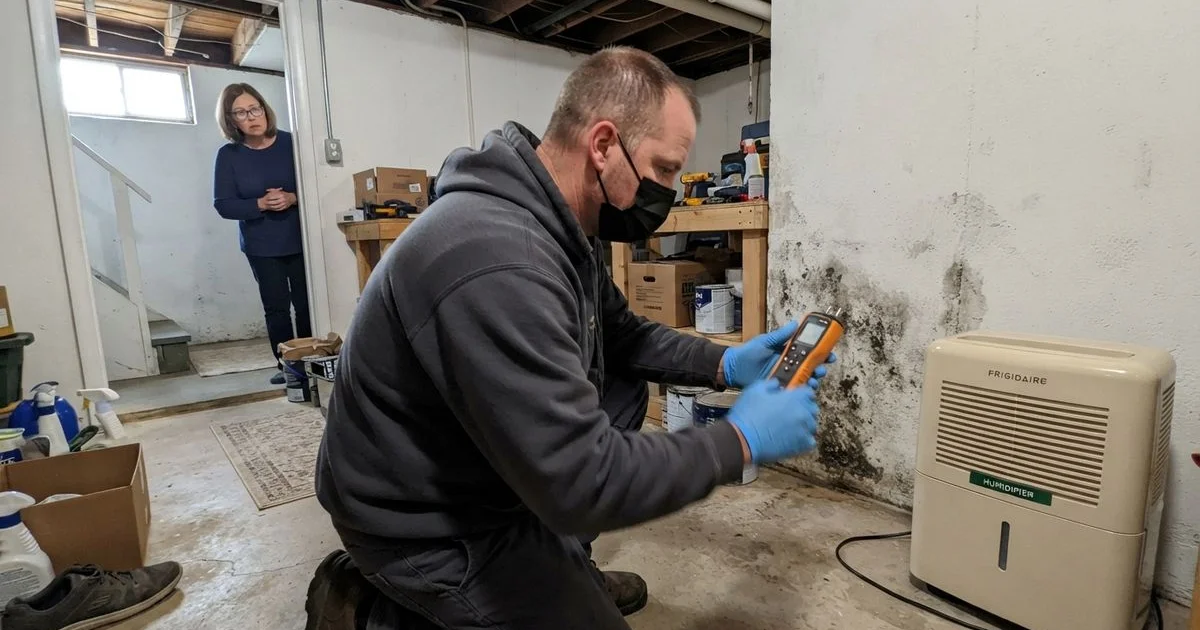
Mold and mildew need moisture and organic material (wood framing, drywall, cardboard, even dust) to grow, and a basement with recurring humidity or seepage provides exactly that. Once mold establishes itself, it releases spores into the air, and basement air doesn’t stay isolated from the rest of the house. It circulates through stairwells, HVAC returns, and gaps around utility penetrations, so a mold problem downstairs can affect air quality throughout the home.
Beyond mold, sustained dampness also breaks down building materials over time: wood framing can rot, drywall can soften and crumble, and stored belongings can absorb moisture and develop their own mildew. None of this happens overnight, which is part of why chronic low-level dampness gets ignored longer than an obvious flood.
Warning signs worth taking seriously
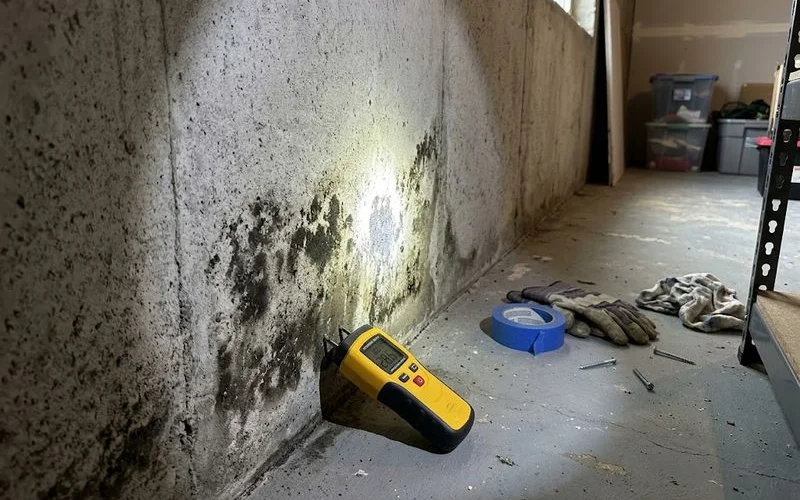
A musty, earthy smell is usually the first sign, even before visible mold appears. Efflorescence, the white or grayish chalky deposit that shows up on concrete or block walls, is another early signal: it means water has been moving through the masonry, even if the surface looks dry now. Condensation on pipes or windows, a general “clammy” feeling in the basement air, and visible dark spots on drywall, wood, or fabric are all signs that moisture has been sitting around longer than it should.
Who notices it first
People with asthma, allergies, or other respiratory sensitivities are usually the first in a household to notice something’s off, sometimes before anyone else can smell or see a problem. Symptoms like increased coughing, sinus irritation, or allergy flare-ups that seem to track with time spent in or near the basement are worth paying attention to. Young children and older adults tend to be more sensitive to indoor air quality issues generally, so a finished basement used as a bedroom or playroom deserves extra scrutiny if dampness has been a recurring issue.
| Sign | What it usually means |
|---|---|
| Musty or earthy smell | Mold or mildew growth, even if not visible yet |
| White, chalky deposits on concrete (efflorescence) | Water has been moving through the wall or floor |
| Visible dark spots on drywall or wood | Active mold growth requiring attention |
| Condensation on pipes, windows, or walls | High humidity levels that support mold growth |
| Worsening allergy or respiratory symptoms indoors | Possible sign air quality is being affected |
Humidity levels matter even without visible mold
Mold doesn’t need standing water to grow, sustained high humidity is enough. A basement that never floods but consistently reads above roughly 60% relative humidity still creates conditions mold and dust mites thrive in. A simple hygrometer, available cheaply at most hardware stores, gives you a real number instead of guessing based on how the air feels. If humidity stays elevated even on dry days, that points to a ventilation or moisture-source problem worth investigating before mold actually appears, not after.
Addressing the source, not just the symptom
Wiping down visible mold without fixing the moisture source is a losing battle, since the mold reliably comes back as long as the underlying dampness continues. A vapor barrier, a dehumidifier, and proper drainage (whether that’s grading, gutters, or a full drain tile system) address the actual moisture load in the space. Crawl spaces are a common blind spot: a musty smell upstairs sometimes traces back to a crawl space that’s never been sealed or encapsulated, since that air rises into the living space above.
If mold is already visible and covers more than a small, easily cleaned area, or if it keeps returning after cleaning, that’s generally a job for a professional who can address both the growth and the moisture source together, rather than a repeat weekend project. Once you’ve hired someone to fix the moisture source, knowing what to expect during the job itself helps you tell a thorough fix from a rushed one.
Our basement waterproofing category lists Rock County contractors who handle both the moisture source and, in some cases, mold remediation directly. Learn how we evaluate those listings on our ranking method page, or head back to the Rock County Waterproofing Guide home page to browse the full list.
FAQ
- Is a musty smell in the basement always a health problem?
- Not automatically, but it's always a signal worth investigating. A musty odor usually means mold or mildew is growing somewhere, even if you can't see it, and basement air does mix with the air upstairs more than most people realize.
- Who's most at risk from basement mold and humidity?
- People with asthma, allergies, or other respiratory conditions tend to notice symptoms first and worst. Young children and older adults are also generally more sensitive to poor indoor air quality than a healthy adult.
- Can I just clean visible mold myself?
- Small, contained surface mold on a hard surface can sometimes be cleaned with soap and water or a mild bleach solution, but that doesn't address why it grew there. If mold keeps coming back, covers a large area, or you're not sure what you're looking at, treat it as a job for a professional rather than a repeat cleaning project.
- Does fixing the water problem automatically fix the mold?
- Stopping the moisture source is necessary but not always sufficient. Existing mold growth may still need to be removed or remediated even after the water intrusion is fixed, since mold doesn't go away on its own once it's established.