What waterproofing costs in Rock County and what changes the price
By Sofia Kaur · Updated 2026-08-03
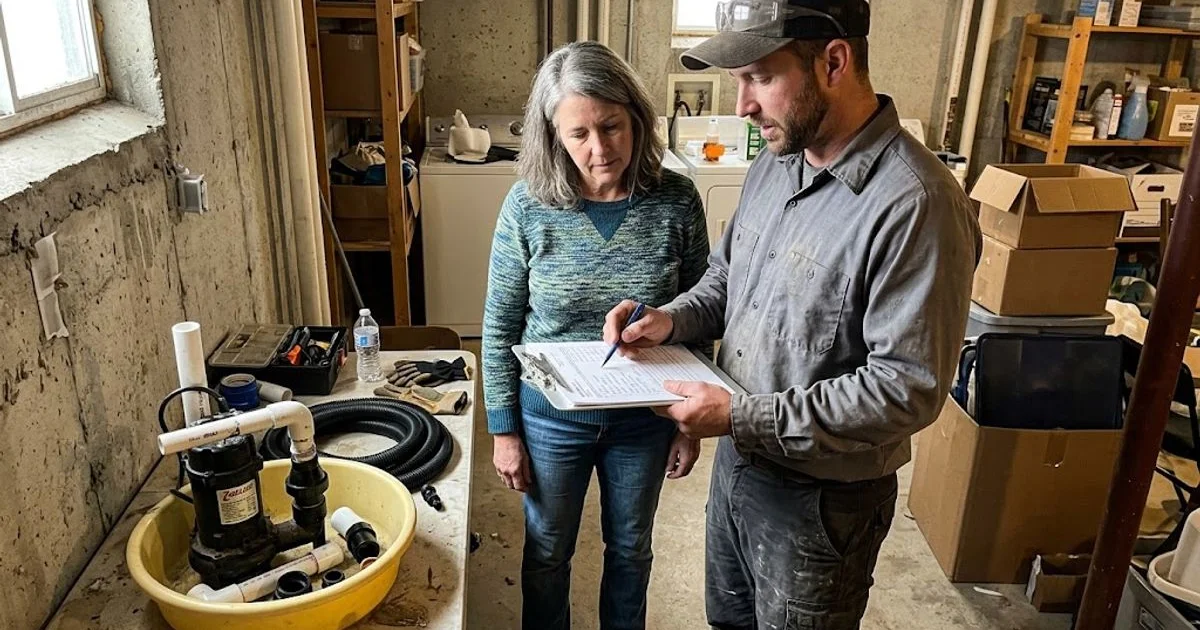
Rock County’s clay-heavy soil, a water table close to the surface near the Rock River, and Wisconsin’s freeze-thaw winters mean the question isn’t really “should I waterproof my basement,” it’s “which method, and what does it cost.” The honest answer is that price depends heavily on what’s actually wrong, not just the square footage of your basement.
The three cost tiers
Waterproofing pricing generally splits into three tiers based on the method, not the size of the house.
Interior sealant or crack injection. For a hairline crack or minor seepage in one spot, a contractor injects epoxy or polyurethane directly into the crack, or applies a cementitious coating to a small area. This is the least invasive and least expensive option, generally a few hundred dollars up to around $2,500 depending on how many cracks or how much wall area needs treatment.
Interior drain tile and sump pump. When water is coming in along the floor-wall joint or the basement floods during heavy rain, contractors often cut a channel around the interior perimeter, install perforated pipe, and route it to a sump pump. This is a bigger job involving concrete cutting, and it typically lands between $5,000 and $12,000 for an average basement.
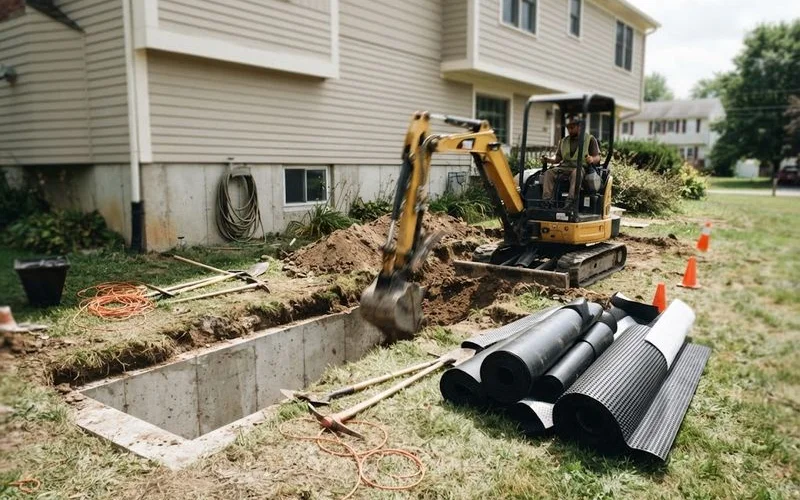
Exterior excavation and membrane. The most thorough and most expensive option involves digging down to the footing outside the house, applying a waterproof membrane or dimple board, and often replacing failed drain tile. Because it involves heavy equipment, landscaping disruption, and labor-intensive digging, this typically runs $10,000 to $25,000 or more, and can go higher depending on how much of the foundation perimeter needs to be exposed.
What actually moves the price within each tier
| Factor | Effect on price |
|---|---|
| Method chosen (sealant vs. drain tile vs. excavation) | Largest single driver; each tier is roughly double to quadruple the one before it |
| Severity (damp smell vs. seepage vs. active flooding) | Active flooding often adds 20-30% over a routine seepage fix |
| Linear feet of wall needing treatment | Scales the labor and material cost within a method |
| Access (finished basement, tight lot, mature landscaping) | Removing and restoring finished walls or landscaping adds cost on top of the base job |
| Sump pump and battery backup add-ons | A backup pump adds a few hundred dollars but protects against pump failure during a power outage |
The single biggest lever is the method, so the most useful question to ask a contractor isn’t “what will this cost” but “why this method and not a cheaper one.” A contractor who explains why they’re proposing drain tile instead of a coating, based on where and how water is actually entering, is worth more than one who jumps straight to a number.
Getting quotes that are actually comparable
Ask every contractor for a written scope that names the specific method, not just a lump sum. A quote that says “waterproofing: $6,800” tells you nothing. A quote that says “interior drain tile, sump pump with backup, 42 linear feet” lets you compare it directly against a competing bid for the same scope. Get two or three quotes before committing, since the corpus of local reviews we track shows pricing conversations are one of the more common friction points between homeowners and contractors, usually because the scope wasn’t spelled out clearly up front.
The Rock County Waterproofing Guide lists local contractors ranked on more than star count, including how consistently they follow through on quoted work. See how those rankings are built on our ranking method page.
Crawl space work and foundation crack repair are priced differently from full basement waterproofing since they’re smaller, more targeted jobs; if that’s closer to what you’re dealing with, it’s worth pricing them separately rather than assuming a basement-wide quote applies.
Before you sign anything
A cheap fix that only treats the symptom, like sealing a wall without addressing why water is pressing against it, tends to come back. Ask what happens if the fix doesn’t hold: is there a written warranty, and does it cover labor as well as materials? A slightly higher quote with a real warranty and a clear diagnosis is often the better value over the life of the foundation, not just the invoice.
Get a professional inspection before assuming which tier you need. Homeowners who guess at the method based on a phone description alone often end up paying for the wrong fix once, then paying again for the right one.
If the total lands higher than you budgeted for, the financing options for basement waterproofing guide covers loans, grants, and payment plans that spread out the cost.
FAQ
- What's a realistic starting budget for basement waterproofing?
- For a single crack or a small area, a few hundred dollars up to around $2,500 covers most interior sealant or injection jobs. A full interior drain tile and sump pump system for an average basement typically runs $5,000 to $12,000. Full exterior excavation and membrane work is the most expensive route, often $10,000 to $25,000 or more.
- Why do two contractors quote such different prices for the same basement?
- Different methods cost different amounts, and not every contractor recommends the same fix for the same symptom. One company might quote a sealant coating while another proposes full drain tile. Ask each contractor to name the specific method in writing so you're comparing the same job, not two different jobs.
- Does a bigger basement always cost more to waterproof?
- Size matters, but severity matters more. A small basement with active flooding and a bowing wall can cost more to fix than a large basement with light dampness. Square footage or linear wall feet is one input among several.
- Is it cheaper to wait until the problem gets worse?
- Rarely. Water that keeps reaching a foundation wall tends to widen cracks and saturate soil further, which can turn a sealant job into a drain tile job, or a drain tile job into an exterior excavation. Addressing a small leak early is usually the cheaper path.